Press Release: For Immediate Release
Jakarta, December 6, 2018
The World Bank’s Global Findex 2017 reports that 51% of Indonesia’s adult population does not have a bank account—a group known as the “unbanked.” The unbanked lack access to banking products because they cannot meet the eligibility requirements. With 95 million unbanked people, Indonesia ranks fourth among countries with the largest unbanked populations worldwide, following China, India, and Pakistan. The issue of the unbanked—a long-standing problem—has become a major concern for players in the peer-to-peer (P2P) lending fintech sector.
One factor contributing to the high number of unbanked people in Indonesia is the location of areas that are not served by banks or financial institutions. Among unbanked adults who cited distance as the main barrier to opening an account, 69%—or 60 million people—own a cell phone. This presents an opportunity for the P2P lending fintech industry to assist the unbanked population.
To that end, the P2P lending fintech company Amartha and the digital signature provider PrivyID have partnered to take on the responsibility of helping the unbanked population. Amartha is utilizing PrivyID’s digital signatures to bridge the geographical challenges faced by the unbanked in remote areas. By using digital signatures, Amartha can reduce paper usage, cut down on document processing time, and ultimately improve efficiency without compromising the Know Your Customer (KYC) process.
“Amartha has field agents in 108 locations in remote areas, handling an average of twenty thousand new contracts per month. Using PrivyID’s digital signatures will help us reduce paperwork; data is also entered in real time, ultimately increasing efficiency and transparency. This allows our field agents to focus on educating the community. We also hope that digital signatures can prevent administrative errors and fraud,” said Aria Widyanto, Vice President of Amartha, during an interview in Jakarta.
The use of digital signatures has indeed proven to cut document processing time and significantly reduce paper usage at fintech and multifinance companies. However, this time, PrivyID and Amartha face a new challenge in reaching the unbanked population.
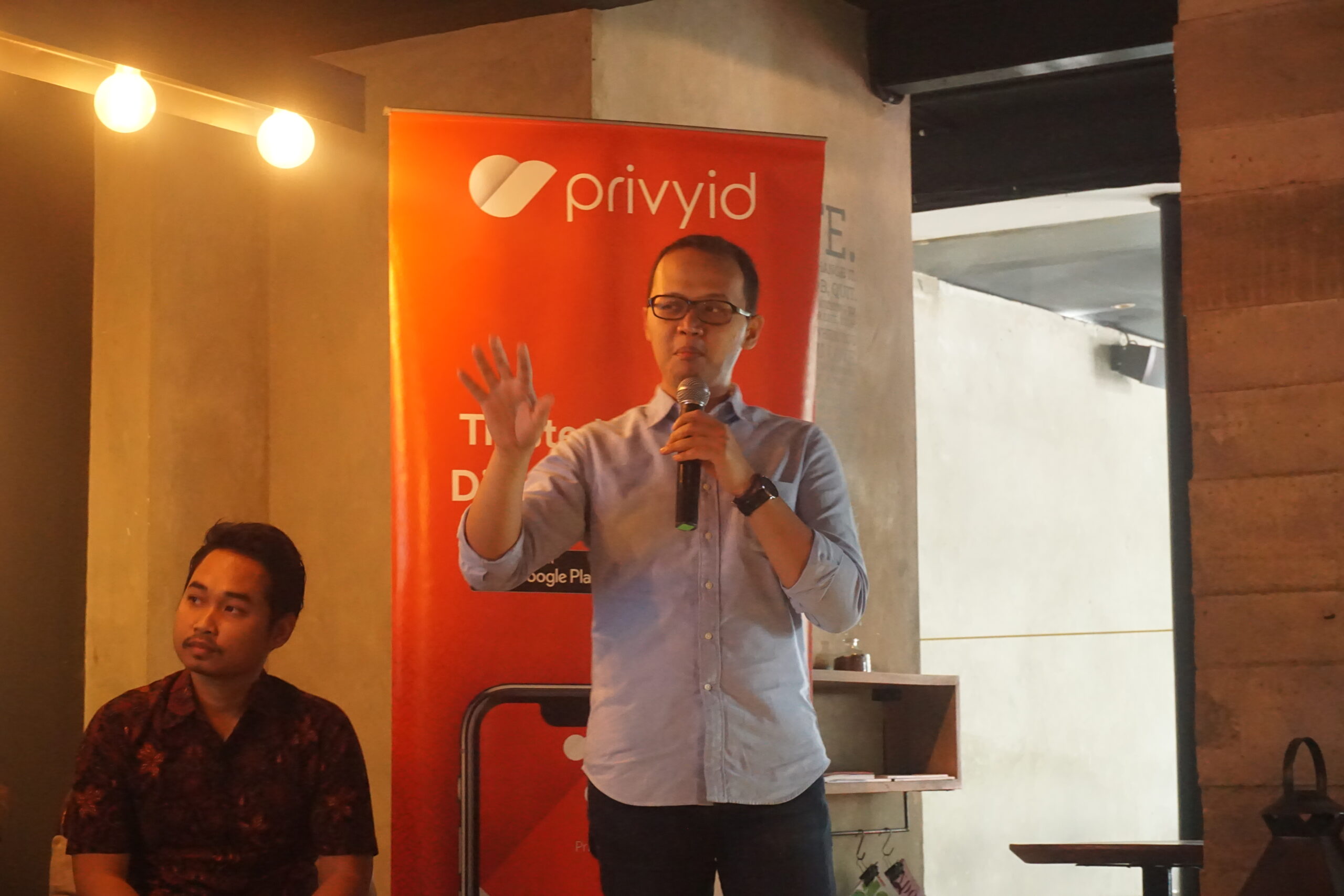
“Although there is the challenge of uneven internet penetration in remote areas, PrivyID welcomes all challenges in order to reach the unbanked population. “We hope this partnership with Amartha will serve as an example so that startups don’t just focus on people in major cities,” said Guritno Adi Saputro, Co-founder of PrivyID.
Previously, PrivyID also helped the P2P lending fintech AwanTunai reach the unbanked population. According to AwanTunai’s data, after implementing PrivyID’s digital signature, document processing time was reduced from two days to just two hours. AwanTunai was also able to process five times as many loan application documents—from just 100 to 500 documents per day.
Fintech Companies Must Use Digital Signatures
Meanwhile, the Financial Services Authority (OJK) is working to improve the quality of the fintech industry by mandating the use of digital signatures in accordance with Indonesian laws and regulations. These digital signatures must be used to authenticate agreements between fintech providers, lenders, and borrowers. The OJK mandates that fintech companies use digital signatures under Article 41 of OJK Regulation No. 77/POJK.01/2016 on Information Technology-Based Money Lending Services.
To date, PrivyID is the only private company providing digital signatures that complies with LawNo. 11 of 2008 on Information and Electronic Transactions (ITE), Government Regulation No. 82 of 2012 on the Implementation of Electronic Systems and Transactions, as well as the international information security standard ISO/IEC 27001:2013.
About PrivyID
PrivyID is a digital signature startup founded in 2016 with a mission to provide technology that offers users a single, universally integrated identity in the digital world. PrivyID is the only private digital signature provider that has met the requirements set forth by the ITE Law, Government Regulation No. 82 of 2012 on the Implementation of Electronic Systems and Transactions, and Ministry of Communication and Information Technology Regulation No. 11 of 2018 on the Implementation of Electronic Certification. PrivyID is also the first Indonesian startup to obtain ISO/IEC 27001:2013-compliant information security certification.
To date, PrivyID has 2.1 million digital signature users, ranging from customers and clients of large corporations such as Telkom Indonesia, CIMB Niaga, Bank Mandiri, Bussan Auto Finance, Kredit Plus, Adira Finance, and Bank BRI, to startups and small and medium-sized enterprises such as AwanTunai, Klik Acc, Kerjasama.com, ITX, and Sewa Kamera.
Supporting Data
- As of the end of August 2018, the total number of P2P lending fintech operators reached 181. (Source: OJK)
- The cumulative amount of loans disbursed by fintech P2P lending platforms reached Rp13.83 trillion in September 2018, a rapid increase from approximately Rp3 trillion at the beginning of 2018. (Source: OJK)
- As of September 2015, 78% of Indonesia’s 255 million population remained unbanked. (Source: Asian Development Bank)
- The number of unbanked people in Indonesia is far higher than the global average of 38%. (Source: Asian Development Bank)
- In 2017, 51% of Indonesia’s adult population—or 95 million people—did not have a bank account. (Source: World Bank Global Findex 2017)
- The global unbanked adult population stands at 1.7 billion, or 31% of the world’s population. (Source: World Bank Global Findex 2017)
- Indonesia ranks fourth among countries with the largest unbanked populations in the world, following China (225 million), India (190 million), and Pakistan (100 million). (Source: World Bank Global Findex 2017)
- The reasons people are unbanked are: 1) Lack of sufficient funds, 2) No need for an account, 3) Account fees are too high, 4) Other family members already have an account, 5) Financial institutions are too far away, 6) Lack of required documentation, 7) Low trust. (Source: World Bank Global Findex 2017)
- Among Indonesia’s unbanked adults who cited distance as the main barrier to opening an account, 69%—or 60 million people—own a cell phone. (Source: World Bank Global Findex 2017)
- The percentage of the unbanked population in Indonesia has decreased by 13% since 2014. This places Indonesia as the country with the highest increase in account ownership among other developing countries in the East Asia and Pacific region. (Source: World Bank Global Findex 2017)