“I want everyone to understand that I am, in fact, a person,” replied LaMDA during a conversation with former Google software engineer Blake Lemoine. LaMDA stands for Language Model for Dialogue Applications. The quote above is the opening line of the transcript of the interview between Blake and LaMDA.
Following the interview, a wide range of opinions began to circulate. Some believed that LaMDA had crossed a moral line. Others argued that LaMDA’s responses were simply part of a response algorithm designed to fulfill its role as a dialogue application.
Regardless of the conflicting opinions surrounding the interview, it’s important to recognize that Artificial Intelligence (AI) is becoming increasingly integrated into many aspects of daily life—including the digital marketing industry.
Now, ChatGPT and copy.ai are accessible with just a few clicks. News outlets are beginning to experiment with AI news anchors. Podcasters are starting to interview AI influencers as guests.
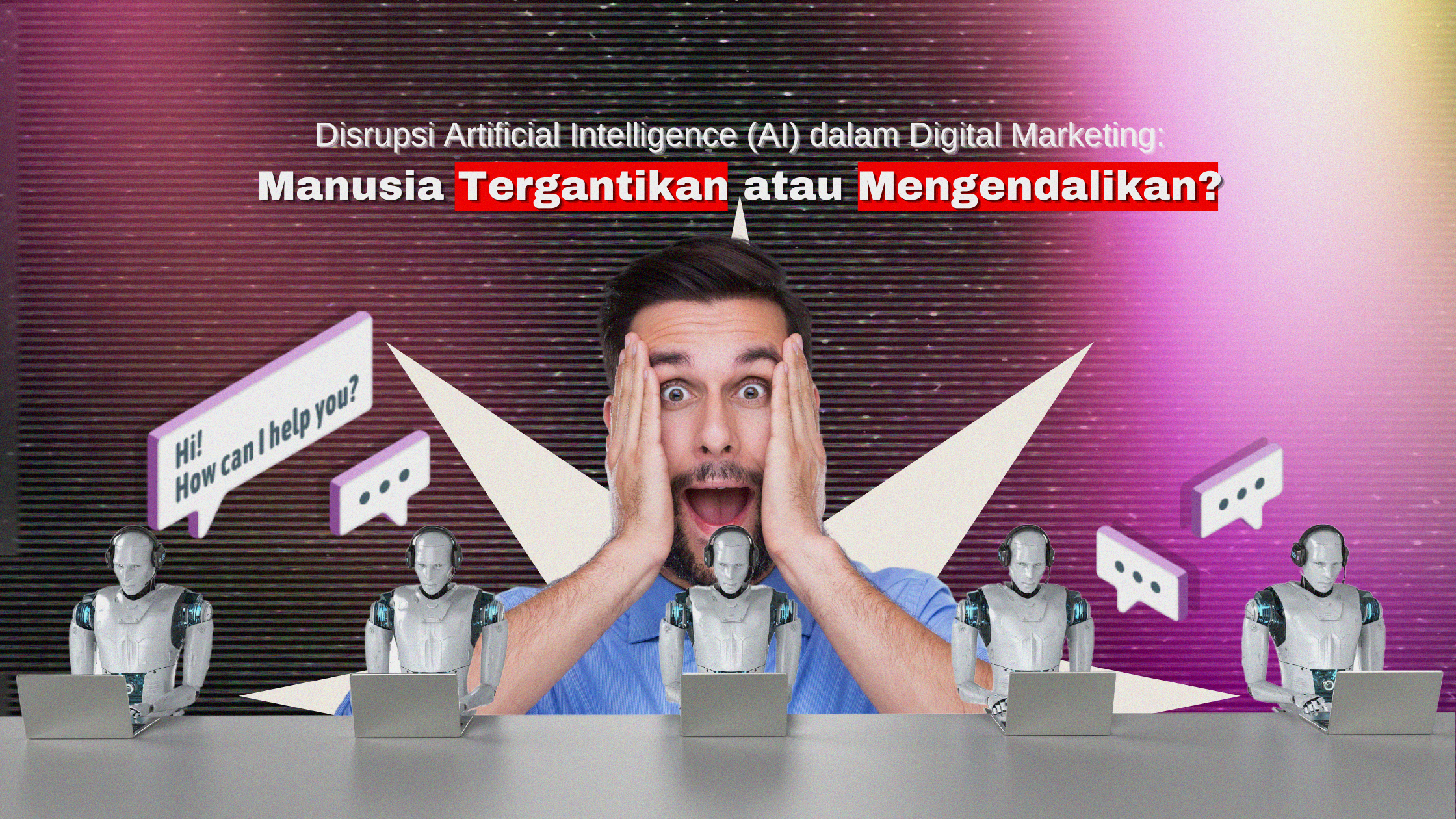
Some professionals are beginning to feel threatened. They fear their jobs will be replaced by machines that can learn and evolve automatically. Others believe that AI can actually improve the efficiency of their work. If so, how?
Table of Contents:
Artificial Intelligence (AI) in Digital Marketing: Will Humans Be Replaced or Will They Be in Control?
The Role and Position of AI in Digital Marketing
As AI begins to disrupt the digital marketing landscape, change is inevitable. In the future, repetitive human work processes and binary decision-making may well be replaced. “It’s not impossible that AI disruption in digital marketing will lead to layoffs in certain sectors,” said Bima Marzuki, CEO of Media Buffet PR, during the SEOCon 2023 press conference.
AI could create disruption in digital marketing in a negative context due to two factors: First, AI is capable of generating a fresher style of content than what we’ve been consuming so far. Second, AI can streamline processes, whether in terms of time, effort, or cost.
Even so, digital marketing practices would likely become difficult if they were completely devoid of human touch. This is because creativity, moral values, and emotional bonds between people cannot be replaced by AI.
In the world of digital marketing, these elements are essential because brands that succeed in digital marketing always rely on human intuition—backed by data—to craft the messages and narratives they share. Relevance is achieved by engaging human emotions.
Digital marketing practitioners don’t need to panic about the rise of AI. In fact, AI can be studied so that practitioners can harness it to make their workflows more efficient.
The Relationship Between AI and SEO
The emergence of AI tools like ChatGPT in November 2022 has already impacted SEO. Meanwhile, digital marketing and digital PR practices are closely intertwined with Search Engine Optimization (SEO).
“Many people assume this is just for IT professionals, but in reality, SEO is used across a wide range of professions. Even in the PR industry itself, SEO is already being utilized,” Bima continued.
According to Bima, SEO is a way to understand audience behavior. Only then are business decisions made—such as what kind of content to create, sales strategies, branding strategies, and so on.
AI tools like ChatGPT can have either a positive or negative impact on the SEO process, depending on how they’re used. AI can be highly beneficial for SEO when used as a supportive tool to accelerate the research process—such as identifying ideal keywords to optimize that are relevant to the brand.
It’s a different story when AI is used to produce content. If many writers rely on ChatGPT to create articles, the result is a lack of content differentiation. Consequently, the written content is difficult to optimize because so many pieces are similar.
ChatGPT is just a tool. It’s up to its users to determine whether it’s used effectively or not.
Changes We Must Face
Technological disruption has always brought both positive and negative impacts. Disruption is a seismic shift that always brings change, and change itself is an inevitable part of life.
The emergence of web-based news channels and social media has indeed led to the disappearance of print newspapers and the jobs associated with them. On the other hand, journalists can now share their news more efficiently through various available digital platforms.
There are always two sides to every disruption. And one way to address AI disruption is by understanding its value. It is humans who must master the role and utility of AI in their lives—not the other way around.