Try this: Go ahead and Google the keyword “brand penetration.” What do you find?
Spoiler alert: in the English-language search results, the majority of results will likely explain how to measure brand popularity by calculating the ratio of products purchased to the potential market associated with those products.
Meanwhile, Indonesian search results will likely discuss a brand’s efforts to increase the market share of its products or services.
Unlike brand penetration, the search results you find are basic definitions of market penetration. So it’s only natural that the discussion always leads back to sales.
This brief discussion won’t focus on sales, let alone market penetration. It seems like we’re jumping the gun if we’re already getting there before we’ve even started. There are a few steps we need to cover first before we’re ready to discuss that. One of them is brand penetration.
Table of Contents:
What Is Brand Penetration?
Brand penetration is an effort to ensure that the target audience or market not only knows about a brand but also understands the ins and outs of that brand.
For example, when blu by BCA Digital launched, some people may have become aware of blu’s existence. But do they understand what blu is? Do they understand that blu is a digital bank?
Moreover, did they understand that they could invest, top up e-money, and even make cash deposits without a card at any BCA ATM using blu?
Not necessarily.
Going Beyond Brand Awareness
“Brand awareness alone isn’t enough to measure whether a brand is already known by its target market or not. Sure, they know the brand name, but do they understand what the brand actually does?” said Bima Marzuki, CEO of Media Buffet, during an afternoon meeting with the digital team while enjoying a bowl of Mas Faisal’s boiled noodles.
With brand penetration, there’s added value to a brand. Because only when brand penetration is executed effectively can we talk about market penetration.
The Easiest Way to Measure the Success of Brand Penetration
Brand penetration is measured by a person’s understanding of a brand. Although it may seem very qualitative, there are actually several ways to start measuring brand penetration numerically.
These methods are fairly simple and cost-effective—all you need is a tool like Keywords Everywhere to get started.
From there, we proceed from the premise that how people think is reflected in how they search—more specifically, what they search for on Google.
Let’s return to blu by BCA Digital as an example again. In January 2022, when we Googled the keyword “blu BCA,” the related search terms were as follows:
- what is blu bca
- blu bca is
- blu bca digital
- blu bca apk
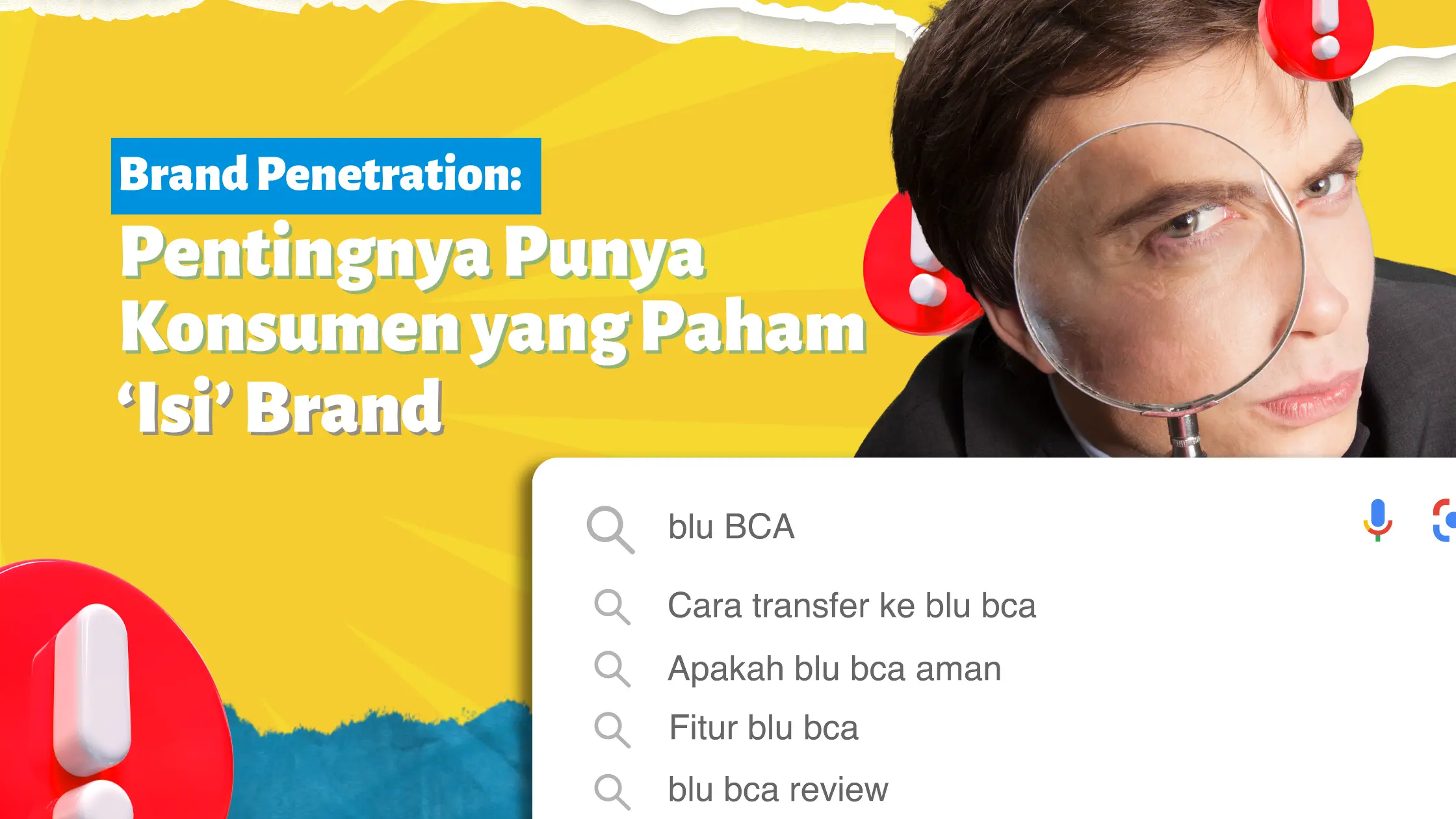
Interestingly, after a full year of collaborating with Media Buffet, there has been a shift in audience behavior reflected in changes to the search suggestions for the same keyword. In January 2023, a Google search for the keyword “blu BCA” will yield the following search suggestions:
- How to transfer to Blu BCA
- Is blu BCA safe
- blu bca features
- blu bca review
In addition to search traffic increasing 2.5-fold over the course of a year, what people are searching for on Google regarding blu has also changed. It has shifted from “what is blu” to “how to use blu’s features.”
“I agree that popularity is a benchmark, but popularity isn’t just about awareness. They know about it, but do they really understand the brand?” continued Bima, who had just finished slurping up the noodle soup in front of him.
Brand Anatomy

Looking at the brand anatomy created by Bima above, there are many brand elements that can be used as benchmarks to measure a person’s understanding of the brand.
So, if you want to find out whether a brand penetration effort has been successful or not, you can use the anatomy above to identify which variables to use as tools for your analysis.